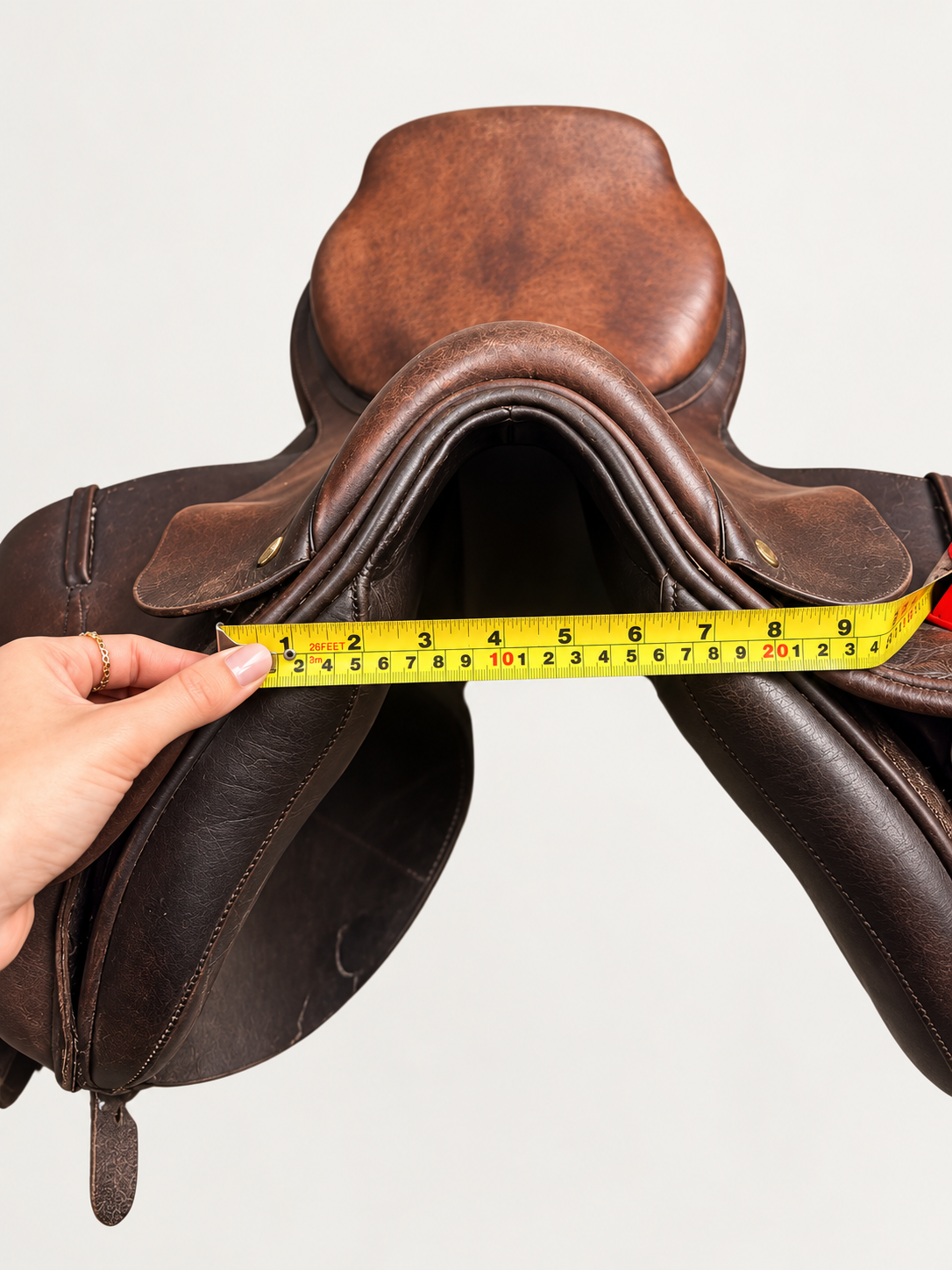
The distance between two D-rings can tell you how far apart two D-rings are. It does not tell you the width of the saddle.
D-to-D measurements turn up constantly in used saddle adverts.
You’ll see something like:
“Medium-wide — measures 9 inches D-to-D.”
Or a buyer will ask a seller to measure between the two D-rings at the front of the saddle to try to work out whether it will fit their horse.
It feels like a sensible measurement.
There are two fixed points. You put a tape measure between them. You get a number.
The problem is that those two points are not a measurement of the tree width.
They are D-rings.
And D-rings can be positioned in different places on different saddles.
D-rings are not tree points
The D-rings at the front of a saddle are attached to the saddle for practical purposes.
They are not fitted there to provide us with a standardised reference point for measuring the tree.
Different manufacturers can position them differently.
Different models from the same manufacturer can position them differently.
They can sit:
- higher or lower
- further apart or closer together
- further forward or further back
So when you measure from one D-ring to the other, the number you get is heavily influenced by where those particular rings happened to be fitted.
Move the rings and you change the measurement.
You haven’t changed the width of the tree.
The pommel shape changes the number too
There is another problem.
Even if two saddles had their D-rings positioned similarly, the shape of the front of the saddle can still make the measurement misleading.
Imagine a saddle designed for a horse with a prominent wither but broad shoulders.
The pommel may be relatively high and more angular to provide the necessary shape and clearance around the wither.
Measured across the D-rings, that saddle could produce a relatively narrow-looking number.
But lower down, where the tree relates to the horse through the front and shoulder area, it could still be a wide fit.
So you could have:
a relatively small D-to-D measurement
on
a genuinely wide saddle.
The measurement is simply describing one part of the saddle, not the tree width itself..
Two saddles can measure the same and be completely different
Now take the problem the other way.
Two saddles might both measure, for example, the same distance D-to-D.
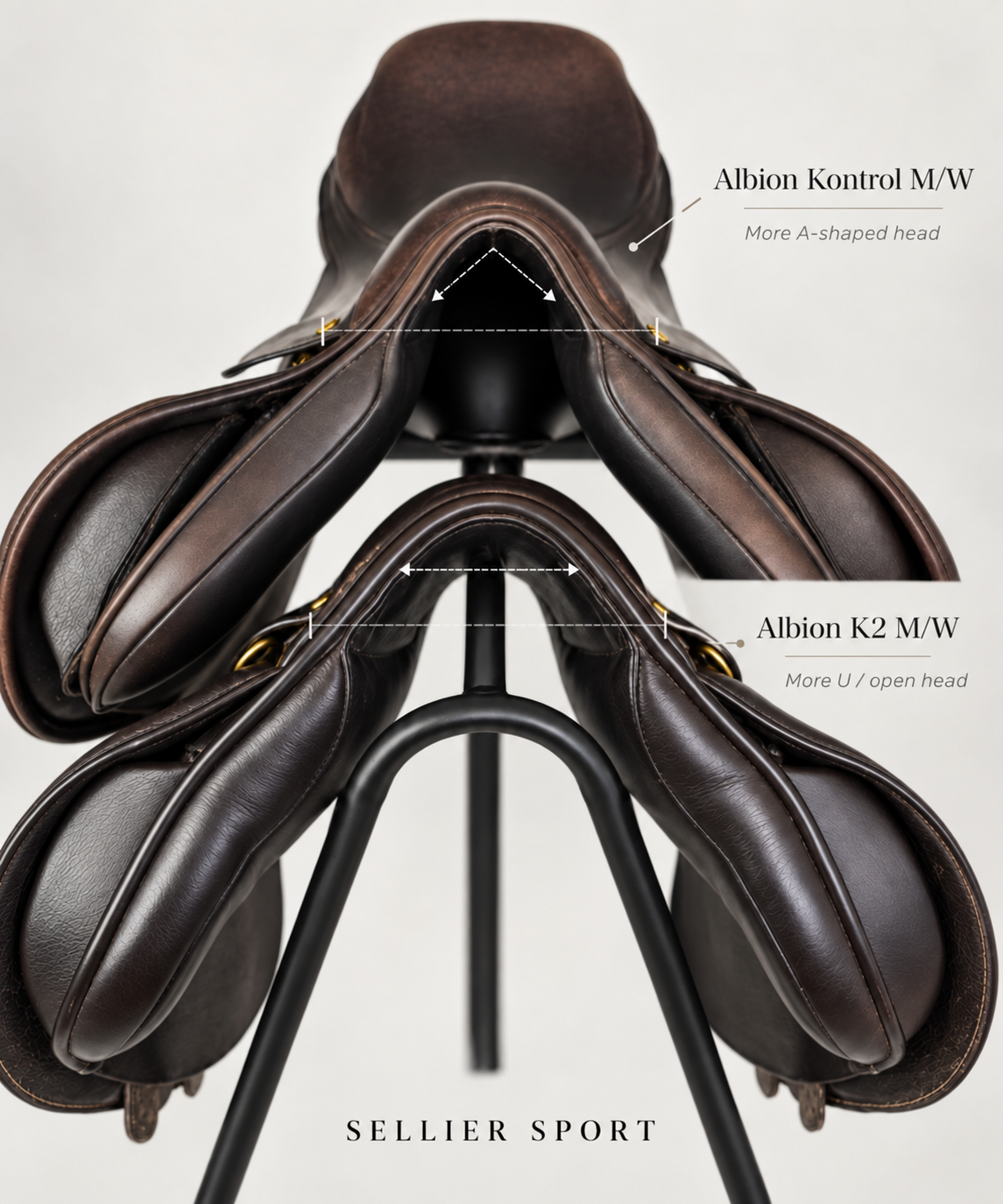
One could have a more angular A-shaped head intended to accommodate more wither.
The other could have a broader, rounder head shape intended for a lower-withered, wider horse.
The D-to-D number could be identical.
The tree geometry underneath can still be very different.
That is why I would never identify saddle width from D-to-D alone.
Two Albion Medium-Wide saddles showing different front tree shapes: Kontrol A-shaped head and K2 U/open head.
Width itself is only part of the story
Even if we could perfectly measure the width at the front, that still wouldn’t tell us whether the saddle suited the horse.
As we’ve already seen with adjustable saddles, width is just one element of tree design.
You also need to consider things such as:
- head shape
- tree-point angle and length
- rail orientation
- overall tree profile
- panel shape and depth
- the horse’s actual conformation
A single measurement cannot describe all of those things.
Why has D-to-D become so popular?
Because it’s easy.
If you’re buying a saddle online, you can’t put the tree on the horse.
You may not know the manufacturer’s coding system.
The seller may not know the original width.
But nearly everyone owns a tape measure.
So D-to-D has become a convenient shorthand.
The problem starts when that convenient number gets treated as though it is a standardised saddle-fitting measurement.
It isn’t.
What should you ask for instead?
- the manufacturer
- exact model
- serial number or stamps
- original stated tree width
- whether the tree has been altered
- whether it has an adjustable gullet system
- photographs of the saddle from useful angles
- information about the tree/profile the model was built on
Some manufacturers have very useful serial-number systems that can tell you significantly more about a saddle than a tape measure between two rings ever could.
And if the saddle is being considered for a particular horse, ultimately the question isn’t:
“What does it measure?”
It’s:
“Does the geometry of this saddle make sense for this horse?”
Is D-to-D completely useless?
Not necessarily.
If you were comparing two genuinely identical saddles, same manufacturer, same model, same generation and the D-rings positioned identically, it might give you a rough comparison between them.
But that is very different from saying:
“9 inches D-to-D means medium-wide.”
There is no universal conversion table that can make that statement reliable across different saddles.
And once you start comparing different models or brands, the number becomes increasingly meaningless.
The takeaway
A D-to-D measurement measures one thing very accurately:
the distance between two D-rings.
It does not directly measure tree width.
It does not tell you the shape of the pommel.
It does not tell you the angle of the tree points.
And it certainly does not tell you whether the saddle fits the horse.
So when you’re buying used, by all means collect measurements.
Just understand what those measurements actually represent.
Beyond the Brand
Measure the saddle, but don’t mistake a number for a fit.
Explore more Beyond the Brand articles →