A prominent wither does not always mean a horse is genuinely high-withered.
Sometimes the underlying skeletal shape is fairly ordinary, but loss of muscle either side of the wither makes it look much more pronounced than it really is.
That distinction matters, because it can completely change the way you think about saddle fit.
High withers and hollowed withers are not the same thing
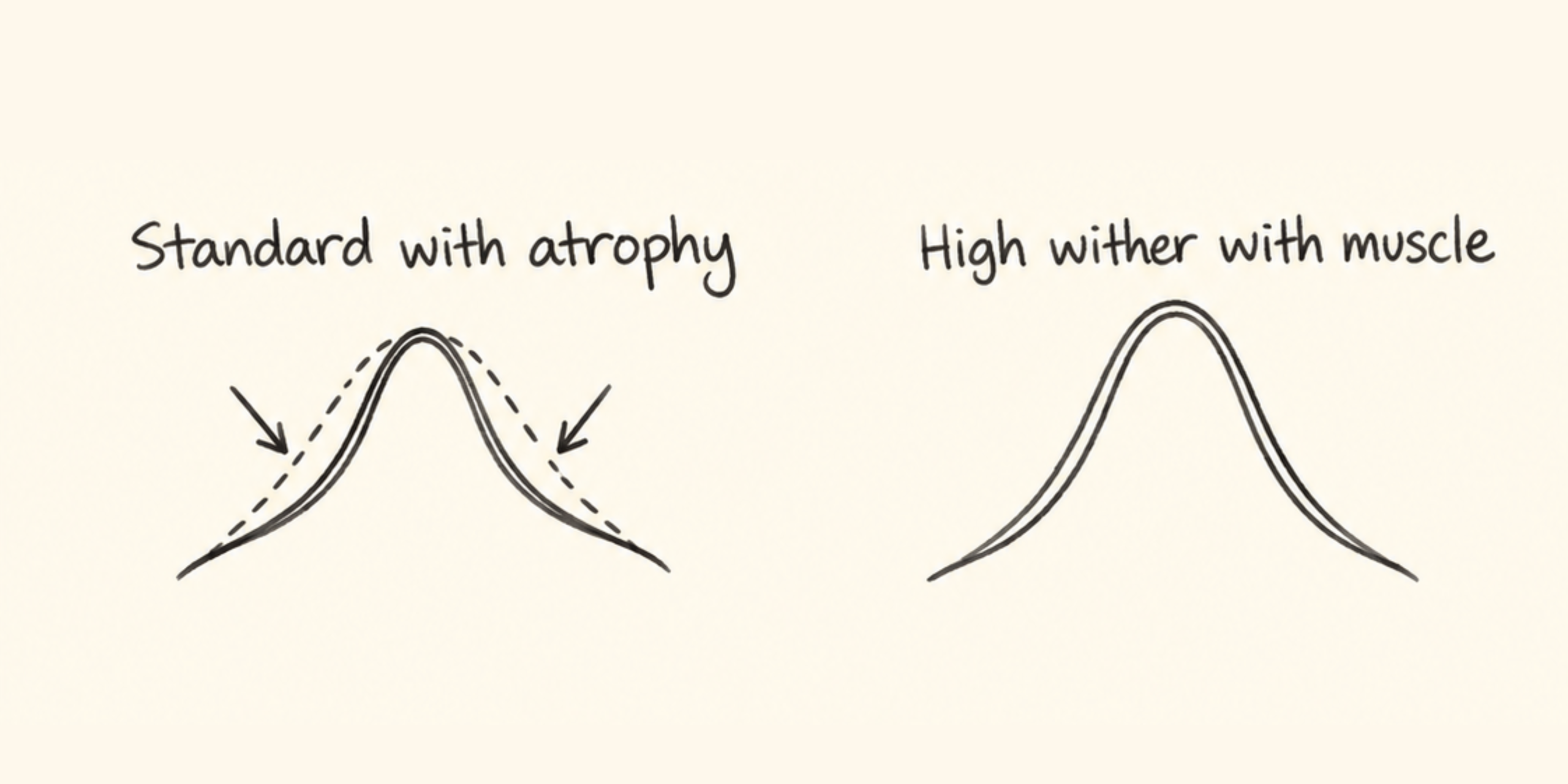
A genuinely high-withered horse has a naturally prominent wither as part of its conformation.
A horse with muscle loss may instead have a medium or fairly standard underlying wither, but appear much narrower through the front because the musculature either side has reduced.
Visually, both horses can look similar from above or from the side.
But they are not necessarily the same saddle-fitting problem.
Look at the whole shape, not just the highest point
When assessing a horse, it is easy to focus on the top of the wither.
The more useful question is:
What is happening either side of it?
Look at the area behind the shoulder and along the upper thoracic region.
Is there a smooth, well-supported transition away from the spine?
Or is there a hollow either side of the wither creating a sharper, more angular appearance?
That hollowing can make a horse look “high withered” even when the underlying skeletal shape is not particularly extreme.
Comparison of a standard horse wither with muscle atrophy and a true high wither with correct muscle development.
Why this can affect saddle choice
If the horse is assumed to be naturally high-withered, the obvious reaction may be to look for a high-wither saddle or a much deeper front panel.
Sometimes that is appropriate.
Sometimes it is not.
If the apparent height is being created partly by muscle loss, a very high-withered saddle design may simply sit around the current hollow rather than suit the horse’s underlying structure.
That can become especially relevant if the horse later develops more muscle.
The saddle that appeared suitable when the horse was hollow may become too restrictive or poorly balanced as the shape changes.
Muscle can change the picture
A horse’s back is not static.
Training, time off, discomfort, age, workload and changes in posture can all alter the musculature around the wither and shoulder.
This means saddle fit should sometimes be viewed as a moving picture rather than a permanent answer.
Where muscle loss is present, the aim may be to support the horse appropriately now while also allowing for the possibility that the shape may change.
That is one reason regular saddle checks can be particularly useful during rehabilitation or changes in workload.
Does that mean using pads or shims?
Sometimes temporary support can be useful.
A carefully chosen shim or corrective pad may help support an area that is currently lacking muscle while the horse develops.
But padding should not be used automatically.
Adding thickness under a saddle can also change balance, clearance and pressure.
It only works when the saddle is broadly suitable in the first place and the additional support is correcting a specific issue.
A pad cannot turn the wrong tree or wrong panel configuration into the right saddle.
The cause of the muscle loss still matters
Not every hollow behind the wither is simply a saddle issue.
Changes in muscle can be associated with workload, posture, pain, previous saddle pressure, asymmetrical movement or other physical factors.
The saddle should therefore be considered as part of the wider picture.
If significant or unexplained muscle loss is present, it may also be appropriate to involve the horse’s vet, physiotherapist or other suitably qualified professional.
What should you actually look for?
Instead of asking only:
“Does my horse have high withers?”
It is often more useful to ask:
“What is the underlying shape of this horse, and how much of what I am seeing is muscle?”
That distinction can help avoid choosing a saddle purely from the visual impression of a prominent wither.
The takeaway
A horse can look high-withered without having an unusually high-withered skeletal shape.
Muscle loss either side of the wither can exaggerate the appearance dramatically.
That means the answer is not always simply to reach for a high-wither saddle.
The better approach is to assess the whole horse, the underlying structure, the current muscle development and the way the saddle interacts with all of it.
Horse first. Brand second.